Client Profile
Country: Qatar
Industry: Frozen Food Distribution, HoReCa Distributors
Business Model: Distribution & Wholesale
Customer Segment: HoReCa — Hotels, Restaurants & Food Service Businesses
Products: Frozen Meat, Poultry, Lamb, Vegetables & Other Frozen Products
ERP: Odoo Community
Business Impact (after implemenation)
As Reported by client directly
Planning time reduced by 75%
Daily Order dispatch planning reduced from 1 hr to 15 min.
Paperwork reduced by 50%
Manual invoices, spreadsheets, screenshots and end-of-day reconciliation were replaced with system-driven workflows.
Cash Reconciliation is realtime
Driver-wise cash balances can be tracked from the system instead of being manually reconstructed at the end of the day. No dependency on Accountant
Realtime inventory visibility
Carton and weight calculations are generated from product master data, eliminating manual calculation/ human error. Inventory is managed based on purchase and dispatch orders
All in one system
Sales, purchase, dispatch and warehouse teams now work from the same system instead of exchanging multiple spreadsheets, emails and WhatsApp messages.
The Business
The company imports frozen food products directly from international suppliers and distributes them to hotels, restaurants and other businesses across the HoReCa sector.
With 148 SKUs and peak volumes of 100–150 orders per day, the business operates in a high-frequency distribution environment where orders need to be accurately planned, picked, dispatched and delivered every day.
Before the ERP implementation, much of this operation depended on a combination of Tally, Excel, email, WhatsApp and manual paperwork.
As order volumes increased, the challenge was no longer simply recording transactions. The business needed a system capable of coordinating the entire operation—from sales order capture and purchasing to dispatch, delivery, invoicing, payment collection and sales commissions.
The Challenge
Managing High-Volume Orders Through Excel
Sales orders received through different channels were manually entered into Excel.
The team maintained daily order sheets containing customer information, products, quantities and delivery dates.
The dispatch manager then used these spreadsheets to determine which orders needed to be delivered today and which could be scheduled for the following day.
This created significant manual work and made it difficult to maintain a single source of truth.
Manual Driver & Dispatch Planning
Once the daily schedule was prepared, the dispatch manager manually assigned orders to 15–20 drivers. Drivers received their delivery instructions through summaries, screenshots and WhatsApp communication.
The process required continuous coordination between sales, dispatch, drivers and the warehouse.
Manual Carton & Weight Calculations
Different products were sold using different units.
Some products were managed in cartons, while others were sold based on weight in kilograms.
The team previously had to manually calculate quantities, cartons and weights while preparing dispatches.
This became particularly time-consuming when dealing with a large number of orders every day.
Fragmented Warehouse Coordination
The company operated through a third-party warehouse.
After dispatch planning, the team manually prepared and emailed warehouse instructions containing details about the driver and material that needed to be prepared.
The warehouse therefore depended on manually prepared communication to execute daily dispatches.
WhatsApp-Driven Delivery Operations
Drivers relied heavily on WhatsApp for delivery instructions and customer locations.
Customer locations were manually shared and drivers had to switch between communication tools and their operational paperwork during deliveries.
Manual Invoicing & Cash Reconciliation
At the customer's location, drivers handled delivery, invoicing and payment collection.
At the end of the day, the dispatch manager had to manually reconcile:
Orders assigned to each driver
Delivered orders
Invoices generated
Payments received
Outstanding payments
Cash expected from each driver
With 15–20 drivers operating simultaneously, this created a significant reconciliation burden.
The Requirement
The company needed a centralized system that could connect the entire distribution lifecycle.
The solution needed to manage:
- Sales order capture
- Delivery scheduling
- Driver assignment
- Warehouse coordination
- Purchase orders and inbound receipts
- Port/supplier pickup
- Product quantity and weight calculations
- Mobile delivery operations
- Invoicing
- Multiple payment methods
- Driver-wise cash collection
- Salesperson targets
- Commission calculation
- Management reporting
The objective was not simply to replace Excel.
It was to create a connected operational workflow where information could move automatically from one stage to the next.
The Solution
Areterix implemented Odoo as the central operational platform, connecting sales, purchasing, dispatch, warehouse coordination, driver operations, invoicing, payments and sales commissions.
1. Centralized Sales Order Management
Sales personnel can now capture customer orders directly into Odoo, regardless of whether the order originated through WhatsApp, email or another communication channel.
Multiple products for the same customer can be consolidated into a single Sales Order.
Once the order is confirmed, the required delivery date can be scheduled
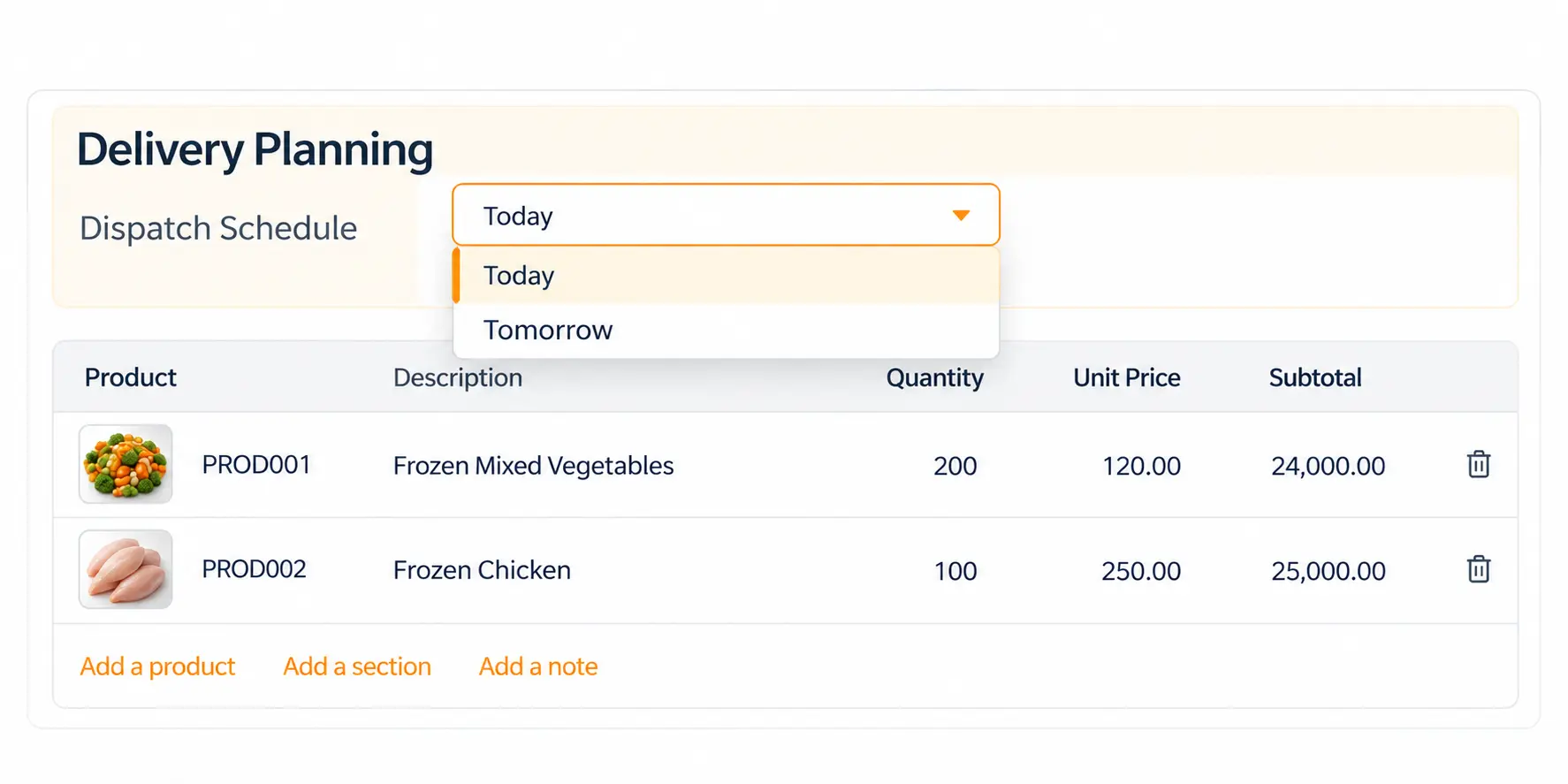
This replaced the need for maintaining separate Excel-based order schedules.
2. Automated Dispatch Planning
Confirmed delivery orders become available to the dispatch manager according to their scheduled delivery date.
The dispatch manager can select the orders that need to go out and assign them to the appropriate driver.
The workflow becomes:
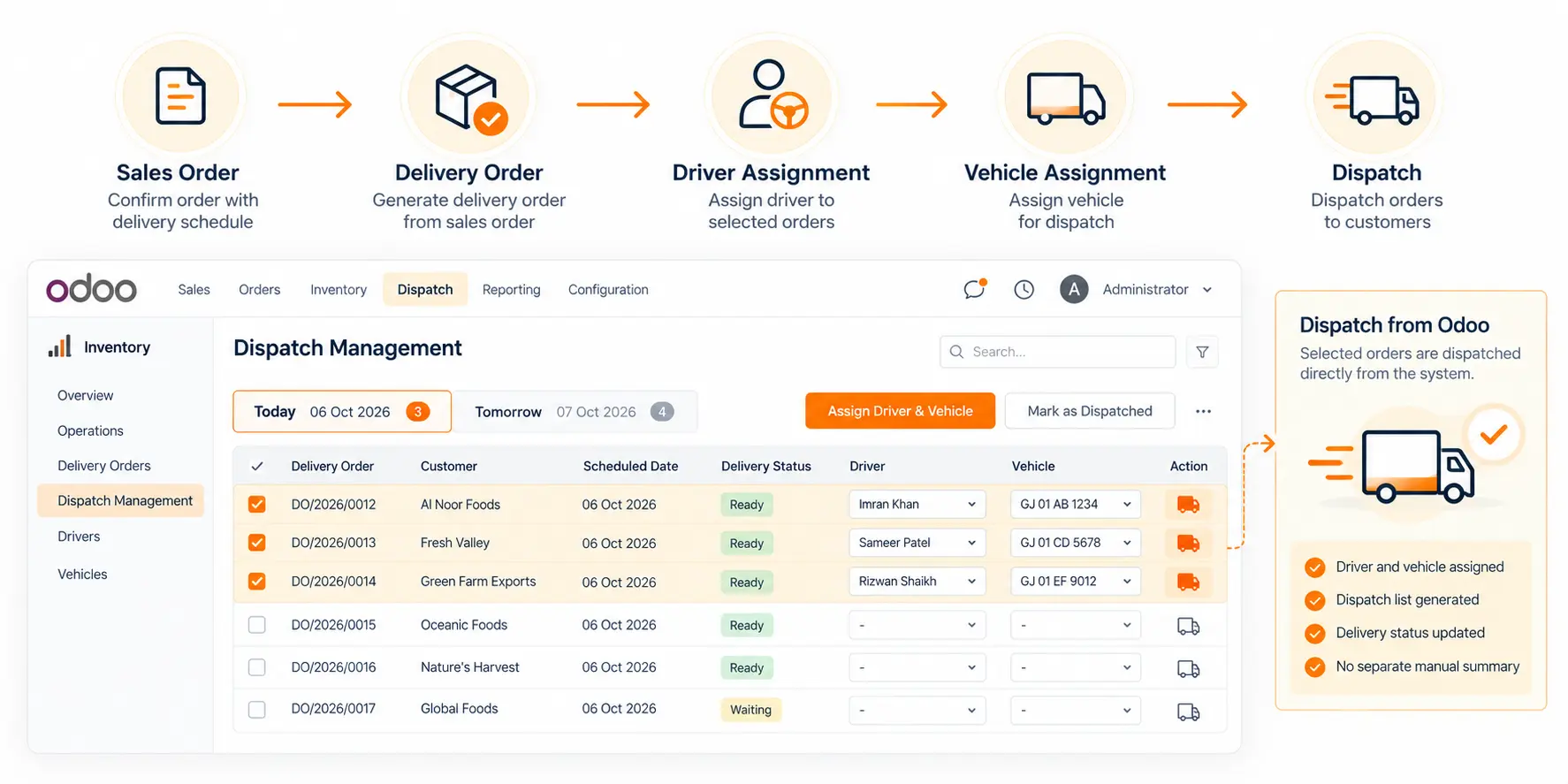
Instead of creating separate manual summaries, the dispatch information is generated directly from the system.
3. Automated Quantity & Weight Calculations
Product masters contain the relevant product information required for dispatch calculations.
Based on the products included in an order, Odoo automatically calculates the required operational quantities such as:
- Cartons
- Weight
- Product quantities
This eliminated repetitive manual calculations previously performed in Excel.
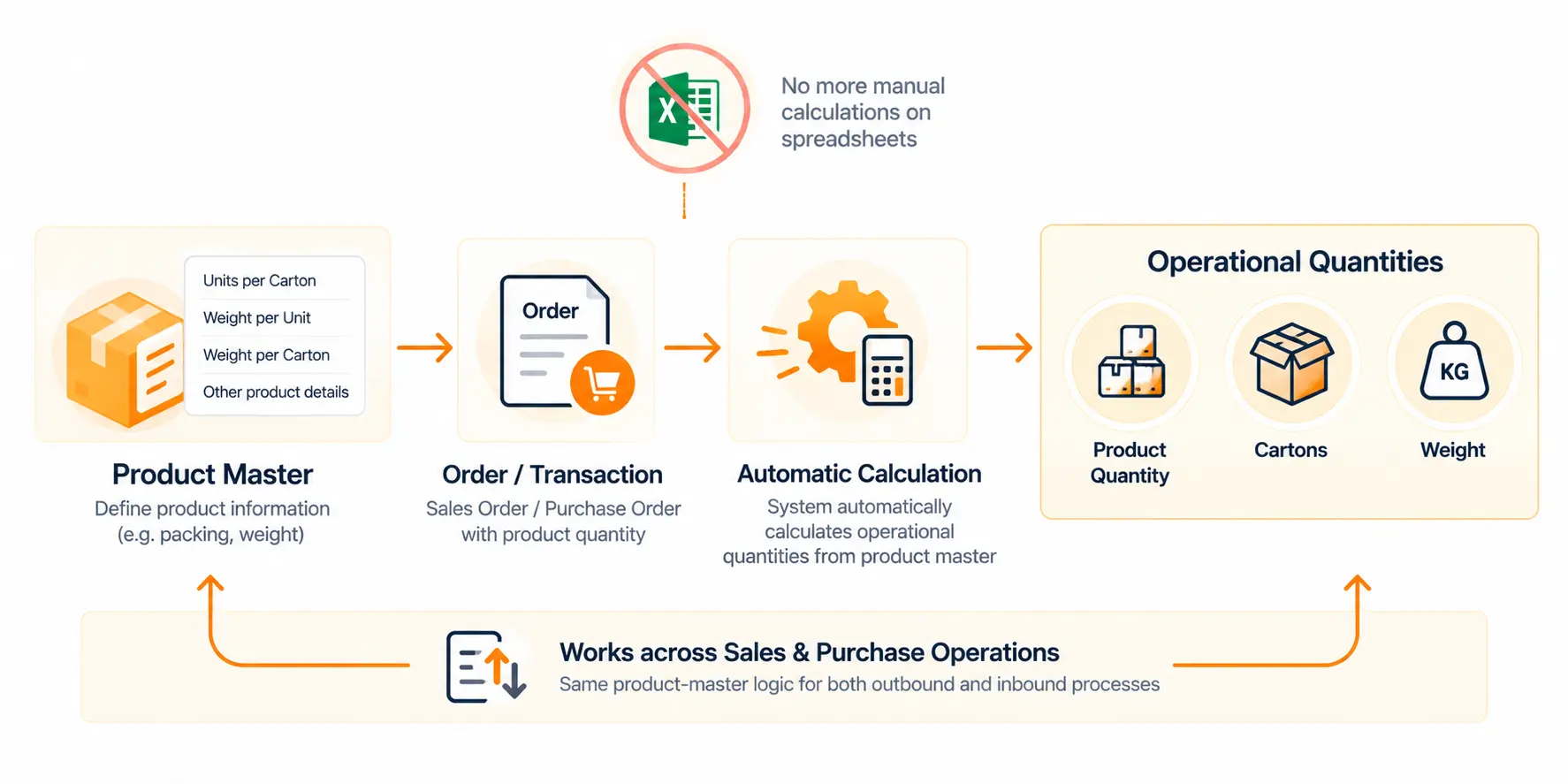
The same principle is also applied to inbound purchasing receipts.
4. Connected Third-Party Warehouse Operations
Once dispatch planning is completed, the warehouse receives the required dispatch information directly from the system.
The warehouse team can see:
- Which driver is coming
- Which orders need to be prepared
- Which products need to be picked
- Required quantities
- Dispatch details
This creates a common operational workflow between the dispatch team and the third-party warehouse.
5. Driver Mobile Operations
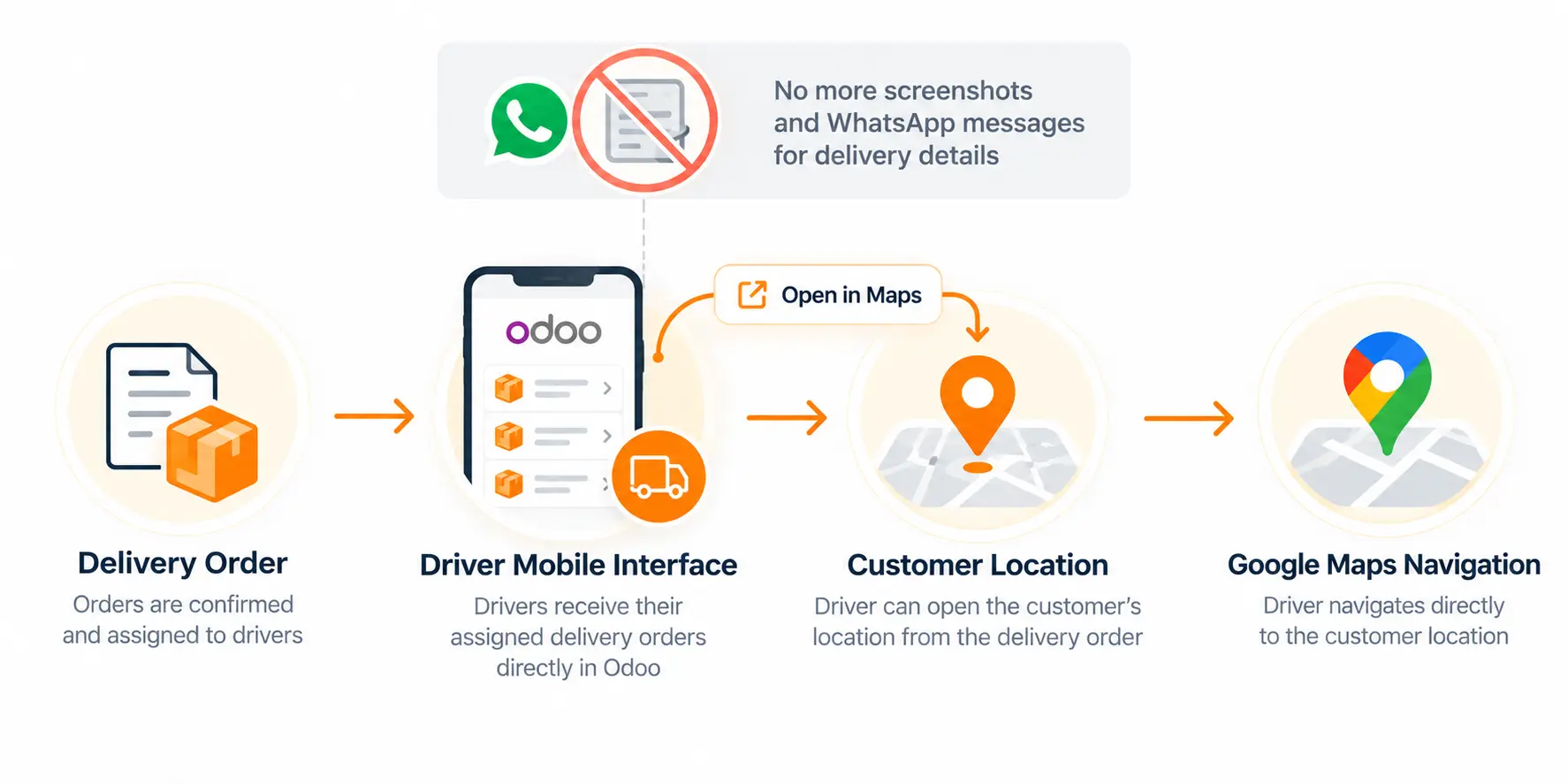
Drivers receive their assigned orders through a mobile interface.
Instead of relying on screenshots and WhatsApp messages, the driver can access the delivery information directly from the system.
For each customer, the driver can open the location through Google Maps directly from the delivery interface.
6. Delivery, Invoicing & Payment
Once the driver reaches the customer, the delivery is completed through the mobile interface.
The driver can generate the invoice and register the payment directly from the same interface.
The system supports multiple payment outcomes, including:
- Cash
- Card
- Bank Transfer
- Payment Not Received
If payment is collected, it is captured immediately against the transaction.
This eliminates the need to wait until the end of the day to understand the payment status of delivered orders.
7. Real-Time Driver Cash Tracking
The payment workflow also provides management with driver-wise cash visibility.
Instead of manually calculating expected collections from delivery sheets, management can see the payment status directly in Odoo.
The system provides visibility into:
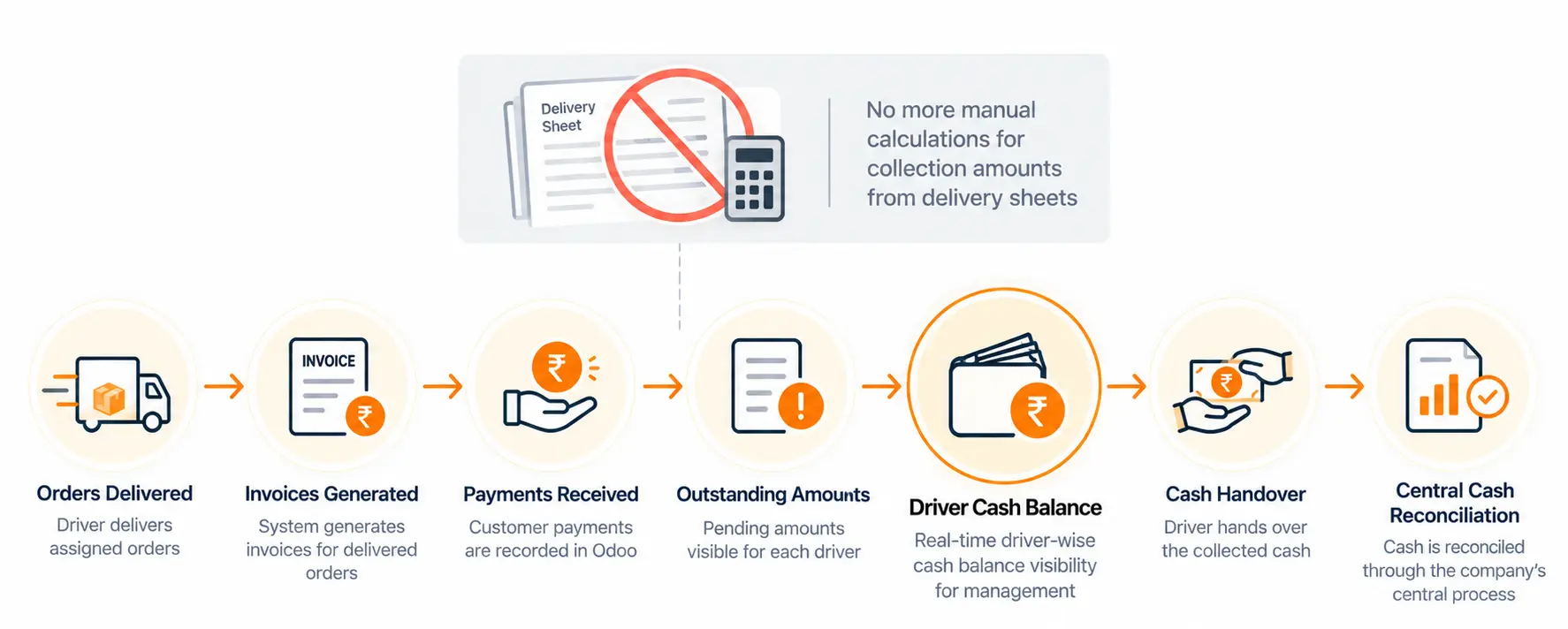
Drivers can then hand over the collected cash, which is reconciled through the company's central cash process.
8. Purchase & Inbound Logistics
The transformation was not limited to outbound distribution.
The company also manages its inbound purchasing process through Odoo.
International purchases follow a connected workflow:
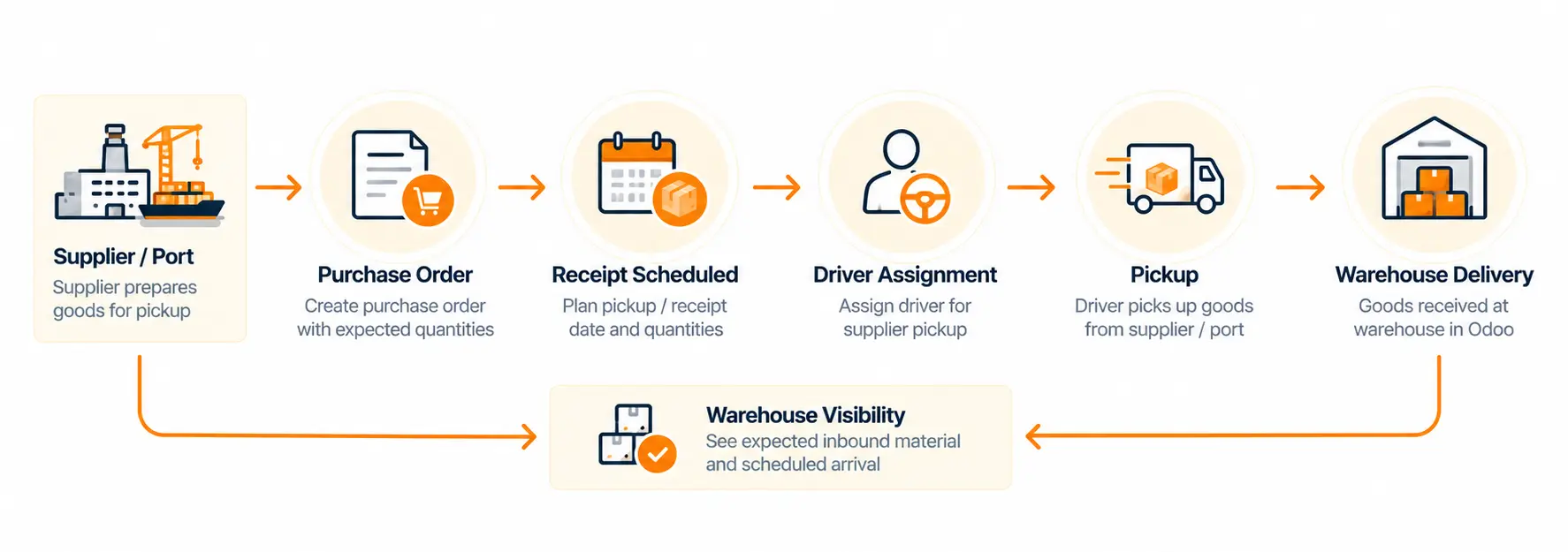
Once a Purchase Order is confirmed, the required receipt is scheduled and a driver can be assigned to collect the material either from the supplier/port and deliver it to the company's warehouse.
The warehouse also receives visibility of expected inbound material and its scheduled arrival.
Carton and weight calculations are automatically generated based on the product master data.
This brought inbound logistics into the same operational system as outbound distribution.
9. Sales Target & Commission Management
A dedicated commission workflow was also developed for the sales team.
Salespersons work against monthly targets, with commission eligibility based on actual fulfilled and paid orders.
The system checks whether:
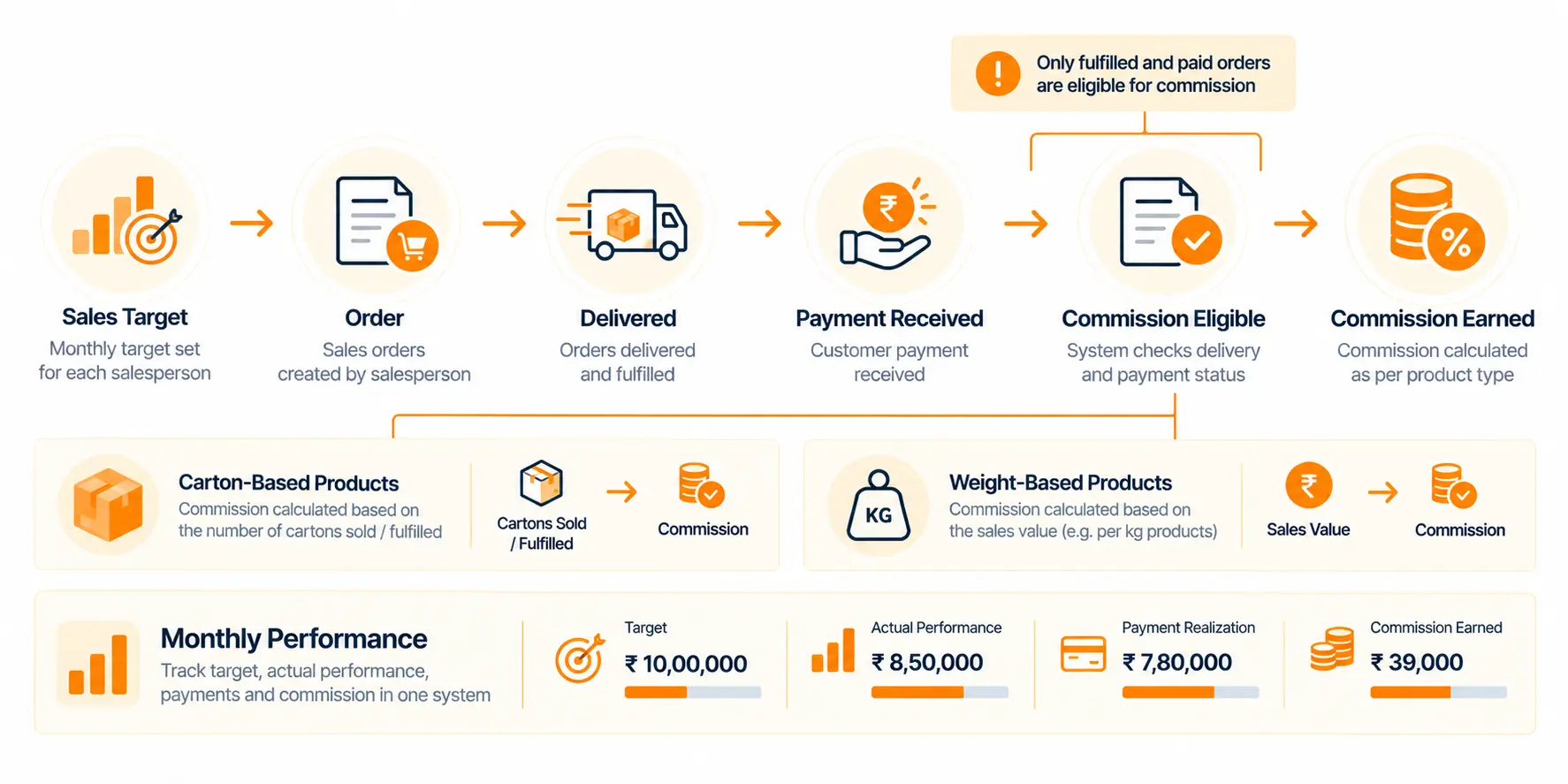
Only after payment is received does the salesperson become eligible for commission.
Management can therefore review monthly:
- Salesperson target
- Actual performance
- Eligible sales
- Payment realization
- Commission earned
This connects salesperson performance with actual realized business rather than simply booked orders.
Key Takeaway
Areterix transformed a fragmented Excel, WhatsApp and paper-based distribution operation into a connected Odoo ecosystem covering sales, purchasing, warehouse coordination, delivery, invoicing, payments and sales commissions.
The biggest value was not simply digitizing existing paperwork—it was connecting the operational workflow so that information captured at one stage automatically becomes available to the next team.
Odoo for Distribution Business | Odoo 20 | Odoo for food business | Odoo for frozen food | ERP for Distribution business | ERP for wholesalers | ERP for Distributors | Odoo 19 | Odoo for Distributors | HoReCa Distributors